

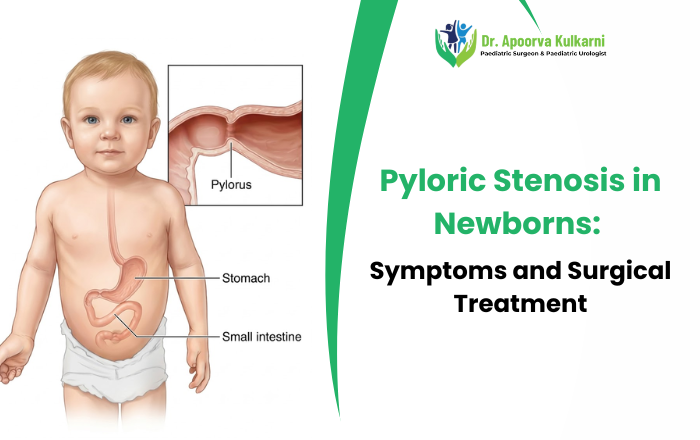
Watching a newborn vomit repeatedly can be alarming for any parent, especially when it happens after almost every feed. While occasional spit-up is normal in babies, a pattern of forceful, repeated vomiting may point to a condition called pyloric stenosis. Understanding what this condition looks like and when to seek medical care can help parents act early and avoid unnecessary worry.
What Is Pyloric Stenosis in Newborns?
Pyloric stenosis is a condition in which the muscle at the outlet of the stomach, called the pylorus, becomes thickened and narrow. This narrowing makes it difficult for milk or formula to pass from the stomach into the small intestine.
As the opening becomes tighter, feeds back up and are forcefully expelled, which is why vomiting is the most noticeable symptom. It is one of the more common reasons infants require surgery in the first few months of life, though it affects only a small percentage of babies overall.
What Causes Pyloric Stenosis?
The exact cause of pyloric stenosis is not fully understood. Researchers believe it likely results from a combination of genetic and environmental factors rather than a single identifiable cause.
It tends to occur slightly more often in firstborn babies and in boys, and there may be a higher likelihood if a parent or sibling had the condition. These are patterns observed in research, not guarantees of who will be affected, and pyloric stenosis can occur in babies with no family history at all.
When Does Pyloric Stenosis Usually Occur?
Pyloric stenosis is not usually present at birth. Babies are typically born with a normal-sized pylorus, and the muscle gradually thickens over the following weeks.
Symptoms most often appear between three and six weeks of age, though they can occasionally begin earlier or as late as three months. It is uncommon for pyloric stenosis to develop after four months of age.
Symptoms of Pyloric Stenosis in Newborns
The symptoms of pyloric stenosis tend to develop gradually and worsen over a period of days to weeks. Common signs include:
- Forceful or projectile vomiting, where milk is expelled with noticeable force, sometimes traveling a short distance
- Vomiting shortly after feeds, often within minutes
- Continued hunger after vomiting, since the baby has not been able to keep the feed down
- Poor weight gain or weight loss, despite frequent feeding attempts
- Fewer wet diapers, which can be an early sign of dehydration
- Changes in bowel movements, such as fewer or smaller stools
- Visible stomach contractions, sometimes seen as a wave-like movement across the upper abdomen shortly before vomiting
It’s worth noting that not every episode of vomiting in a newborn means pyloric stenosis. Many babies spit up or vomit occasionally due to reflux, overfeeding, or minor stomach upsets. What tends to distinguish pyloric stenosis is the forceful, repeated nature of the vomiting combined with ongoing hunger and, over time, poor weight gain.
When Should Parents Seek Medical Attention?
Parents should contact a doctor if their baby has repeated forceful vomiting after most feeds, particularly if it is becoming more frequent or severe. Prompt evaluation is especially important if the baby also shows:
- Signs of dehydration, such as fewer wet diapers, a dry mouth, or unusual sleepiness
- Little or no weight gain over several days
- Persistent fussiness or hunger despite vomiting
- Vomiting that appears to be increasing in force over time
These symptoms don’t confirm pyloric stenosis on their own, but they are reasons to have a baby examined rather than wait and see.
How Is Pyloric Stenosis Diagnosed?
Diagnosis usually begins with a detailed history of the baby’s feeding and vomiting pattern, along with a physical examination. During the exam, a doctor may feel the abdomen for a small, olive-shaped lump, which represents the thickened pyloric muscle. This finding is not always easy to feel and its absence does not rule out the condition.
- Ultrasound is the standard test used to confirm pyloric stenosis. It allows the doctor to measure the thickness and length of the pyloric muscle directly and is generally quick and painless for the baby.
- Blood tests may be recommended to check for dehydration and electrolyte imbalances, particularly if vomiting has been ongoing for some time. These results help guide treatment before any surgery is planned.
Treatment for Pyloric Stenosis
Pyloric stenosis does not resolve on its own and generally requires surgical correction. Before surgery, though, the priority is usually to stabilize the baby.
Repeated vomiting can lead to dehydration and an imbalance in body salts, particularly sodium, potassium, and chloride. If these are present, the medical team will typically correct them with intravenous fluids first. Surgery is usually scheduled once the baby’s hydration and electrolyte levels are stable, since this reduces the risk of complications during and after the procedure.
Pyloromyotomy: The Surgical Treatment for Pyloric Stenosis
The standard surgical treatment for pyloric stenosis is called a pyloromyotomy. During this procedure, the surgeon carefully cuts through the outer thickened muscle layer of the pylorus, without cutting into the inner lining of the stomach or intestine. This relieves the tightness and allows food to pass through normally again.
The surgery is often performed using a laparoscopic approach, using small incisions and a camera, though it can also be done through a single small open incision depending on the baby’s condition and the surgeon’s assessment. It is generally considered a well-established procedure with a good safety record, though as with any surgery, it carries some risks that the surgical team will discuss with parents beforehand.
Recovery After Pyloric Stenosis Surgery
Most babies begin feeding again within several hours of surgery, usually starting with small, frequent amounts that are gradually increased as tolerated. Some vomiting in the first day or two after surgery is fairly common and does not necessarily indicate a problem, though the medical team will monitor the baby closely.
Hospital stays after pyloromyotomy are typically short, often just one to two days, though this can vary depending on how well the baby tolerates feeds and recovers. Before discharge, doctors usually confirm that the baby is feeding adequately and gaining weight appropriately.
Parents are generally advised to attend a follow-up visit to check the baby’s growth and recovery. If vomiting continues beyond the first couple of days after surgery, or if new symptoms develop, further evaluation may be needed.
Key Takeaways
- Pyloric stenosis involves thickening of the stomach outlet muscle, making it hard for feeds to pass through.
- Symptoms usually appear between three and six weeks of age.
- Forceful vomiting after feeds, along with continued hunger, is the hallmark symptom.
- Not all vomiting in babies is caused by pyloric stenosis.
- Ultrasound is the main tool used to confirm the diagnosis.
- Pyloromyotomy is the standard surgical treatment and is generally well tolerated.
- Recovery is usually quick, though it can vary between babies.
Frequently Asked Questions
Q1. What are the first signs of pyloric stenosis?
The earliest signs are usually mild vomiting after feeds that becomes more frequent and forceful over days to weeks, along with the baby remaining hungry afterward.
Q2. Is pyloric stenosis dangerous?
If left untreated, pyloric stenosis can lead to dehydration, weight loss, and electrolyte imbalances. With timely diagnosis and treatment, outcomes are generally good.
Q3. At what age does pyloric stenosis usually develop?
It most commonly appears between three and six weeks of age, though it can occasionally occur earlier or slightly later.
Q4. Does pyloric stenosis always require surgery?
Surgery, specifically pyloromyotomy, is the standard treatment, as the condition does not typically resolve without it.
Q4. What is pyloromyotomy?
Pyloromyotomy is a surgical procedure where the thickened muscle at the stomach outlet is cut to widen the passage, allowing feeds to move normally into the intestine.
Have questions? We’re just a message away! Contact us on WhatsApp — Click Here to Chat with Us
Concerned About Your Baby’s Symptoms? Get Expert Evaluation
Pyloric stenosis can be concerning to witness, but it is a well-recognized condition with an established diagnostic process and treatment approach. Recognizing the pattern of forceful vomiting and ongoing hunger, and seeking timely medical evaluation, allows the condition to be diagnosed and treated appropriately. Most babies recover well after pyloromyotomy and go on to feed and grow normally.
If your baby has symptoms that may be associated with pyloric stenosis, seeking timely medical evaluation is important. Parents in Thane can consider consulting Dr. Apoorva Kulkarni, a Paediatric General Surgeon, Laparoscopic Surgeon, and Paediatric Urologist with MBBS, MS (General Surgery), MCh qualifications and 13+ years of experience, practicing at MRR Children’s Hospital, Thane West, Thane, for evaluation and treatment guidance.
Name – Dr. Apoorva Kulkarni | Pediatric Urologist & Laparoscopic Surgeon | Hypospadias Surgeon | Neonatal Surgery
Address: 1st, Pokhran Rd, Shastri Nagar, Vartak Nagar, Thane West, Thane, Maharashtra 400606
Phone: 83696 31672