

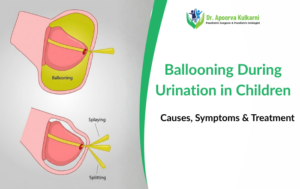
What Is Ballooning During Urination in Children?
Ballooning during urination medically called preputial ballooning or foreskin ballooning occurs when the foreskin of an uncircumcised boy puffs outward like a small bubble during urination. Instead of urine flowing freely, it temporarily collects under the foreskin, causing visible swelling before releasing.
This condition is more common than most parents realize. Studies suggest that up to 8% of uncircumcised boys experience some degree of preputial ballooning during early childhood (ages 2–7), with the majority resolving naturally as the foreskin gradually separates from the glans.
The critical distinction: Occasional ballooning in a child with a natural, non-retractile foreskin is usually physiologically normal. However, ballooning accompanied by pain, urinary tract infections (UTIs), or a scarred, whitened foreskin tip signals a condition called Phimosis which may require medical intervention.
Why Does Ballooning Happen? (Core Causes)
Understanding the entities behind this symptom helps parents and clinicians act appropriately:
1. Physiological Phimosis (Normal)
In newborns and young boys, the foreskin is naturally non-retractile. The glans and inner foreskin are fused by a thin membrane. As the child grows, spontaneous separation occurs the foreskin gradually loosens between ages 3 and 10. During this phase, a temporarily narrow preputial opening may cause urine to pool, producing the balloon effect. No treatment is needed.
2. Pathological Phimosis (Abnormal)
This occurs when the foreskin becomes scarred due to forceful retraction, repeated infections, or a skin condition called Balanitis Xerotica Obliterans (BXO) a chronic, progressive fibrosis. BXO affects approximately 0.6% of boys but is responsible for a significant proportion of surgical phimosis cases. The foreskin tip appears pale, thickened, and inelastic.
3. Recurrent Balanitis
Inflammation of the glans (balanitis) can cause scarring that tightens the foreskin opening over time, worsening ballooning with each episode.
4. Post-Circumcision Meatal Stenosis
Rarely, in circumcised boys, the urethral opening (meatus) can scar and narrow also causing a weak, dribbling or ballooned urinary stream.
Key Symptoms Parents Should Watch For
| Symptom | Likely Significance |
|---|---|
| Visible foreskin balloon, no pain | Often physiological — monitor |
| Balloon + pain or crying during urination | Consult a pediatric urologist |
| Weak urine stream + straining | May indicate significant phimosis or meatal stenosis |
| Recurrent UTIs in boys | Phimosis may be trapping bacteria |
| White/pale foreskin ring | Possible BXO — urgent referral needed |
| Blood in urine after ballooning | Immediate evaluation required |
The Diagnostic Framework: How Doctors Evaluate This
A pediatric surgeon-urologist will typically assess:
- Clinical inspection — foreskin retractability scoring (Beaugé scale)
- Urine flow rate (uroflowmetry) — to quantify obstruction severity
- Urine culture — ruling out UTIs
- Ultrasound of kidneys & bladder — to check for back-pressure effects on upper urinary tract
- Biopsy (if BXO suspected) — to confirm pathological scarring
Treatment Options: From Conservative to Surgical
Step 1 — Watchful Waiting (Ages 2–5, physiological phimosis)
No intervention. Advise parents to never forcefully retract the foreskin. Natural resolution is expected.
Step 2 — Topical Steroid Cream
For mild pathological phimosis, 0.1% Betamethasone cream applied twice daily for 4–8 weeks achieves success in 65–85% of cases by softening the tight ring. This is a first-line, evidence-backed treatment before surgery.
Step 3 — Preputioplasty
A foreskin-preserving surgery that widens the preputial opening without full circumcision. Ideal for boys with pathological phimosis who wish to retain their foreskin. Recovery is fast (3–5 days).
Step 4 — Circumcision
Indicated when steroid treatment fails, BXO is confirmed, or recurrent UTIs persist. In skilled hands, circumcision is a safe, definitive cure with an excellent long-term outcome. Laparoscopic-assisted or laser techniques are now available in advanced centers.
When to Seek a Specialist — Immediately
Consult a Pediatric Surgeon-Urologist (not a general surgeon or pediatrician alone) if your child has:
- Ballooning with pain or urinary retention
- Recurrent urinary tract infections (2+ in a year)
- A pale, scarred, or inelastic foreskin ring
- Weak stream causing straining or incomplete bladder emptying
- A worried parent instinct — always worth ruling out
Trusted Expert in Thane: Dr. Apoorva Kulkarni
For families in Thane and the Mumbai Metropolitan Region seeking specialist care, Dr. Apoorva Kulkarni is a highly regarded Pediatric Surgeon-Urologist with 11+ years of dedicated experience in managing conditions exactly like phimosis and preputial ballooning in children.
Dr. Kulkarni specializes in minimally invasive pediatric urological surgeries including preputioplasty, circumcision, hypospadias repair, and pediatric laparoscopy delivering adult-level surgical precision adapted for young patients. Parents across Thane, Pune, and Navi Mumbai trust Dr. Kulkarni for accurate diagnosis, conservative-first management, and compassionate surgical care when needed.
If your child is experiencing ballooning during urination, a painful stream, or recurrent infections, an early consultation with Dr. Apoorva Kulkarni can prevent complications and give you a clear, honest treatment path often without surgery at all.