


Abdominal pain is a very common symptom in children. The reasons for abdominal pain vary from intestinal colic and mesenteric lymphadenitis to more serious conditions like appendicitis which require surgical attention. In this article, we will understand how to approach a child with acute abdominal pain when he is brought to the hospital.
A step-wise approach helps in differentiating between various causes and narrowing down to the diagnosis.
1. History
Many a times, a good and detailed history-taking itself gives us the diagnosis.
a. Onset and duration
Since when has the been noticed? (hours or minutes or more than 1 day)
b. Site of pain
Which part or quadrant of the abdomen is the pain located and is it radiating? If radiating, then what is the direction of radiation of the pain?
c. Nature of pain
Is it colicky or dull aching or throbbing? Is it continuous or intermittent?
d. Any associated symptoms
Fever, vomiting (bilious/non-bilious), diarrhoea, constipation, abdominal distension, burning micturition.
e. Any similar history of pain in the past?
If yes, what was the treatment taken?
f. For infants
Is the baby on formula milk/cow milk? Any history of lactose intolerance?
2. Examination
After an adequate history-taking, the child should undergo a quick but thorough general and local (abdominal & genital) examination.
a. General examination
Does the child appear sick/lethargic/listless or is the child playful? Are there signs of dehydration? Are the peripheries warm or cold?
b. Vital signs
Is there tachycardia, hypotension, fever, weak pulses (suggestive of sepsis/peritonitis)?
c. Abdominal examination
Is there tenderness/rebound tenderness/guarding/rigidity? It is important to know the difference between the above terminologies, as each of them give separate information.
Tenderness – indicates inflammation of a viscus.
Rebound tenderness – indicates spread of inflammation from viscus to local peritoneum adjacent to the viscus.
Guarding – it is the next stage of peritoneal inflammation where the patient does not allow local abdominal palpation (guards him abdomen on attempting palpation).
Rigidity – it is the last stage where the entire abdomen becomes rigid and does not move even with respiration, due to generalised peritonitis. It is classically seen with bowel perforation with contamination of entire peritoneal cavity.
Are bowel sounds heard on auscultation? Absent bowel sounds can indicate ileus while hyperperistaltic sounds can be heard in obstruction.
d. Genital examination
A very important part of examination in any case of abdominal pain. Testicular torsion and obstructed inguinal hernia commonly present with lower or generalised abdominal pain.
e. Per-rectal examination
In very specific cases (like intussusception), per rectal examination can reveal signs like red-current jelly.
3. Investigations
Various investigations are done simultaneously to aid in the diagnosis.
a. Ultrasound of abdomen
To look for organ of origin of the disease (small bowel, appendix, gall bladder, etc).
b. X-ray of abdomen
An erect x-ray of abdomen can give valuable information like free air under diaphgram, air-fluid levels, etc.
c. Blood tests
CBC, electrolytes, serum creatinine (in renal cases), liver function tests (in biliary system cases).
d. CECT abdomen
Done only if ultrasound is not conclusive and clinical evaluation does not give clarity.
4. Management
Till the time the investigation reports are received, initial management is started.
a. IV fluids
Started if patient seems dehydration or lethargic.
b. Nasogastric tube insertion
If suspicion of intestinal obstruction like bilious vomiting.
c. Surgical management
If required, is carried out according to diagnosis.
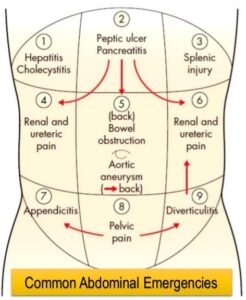
Various differential diagnoses according to quadrants of abdominal pain
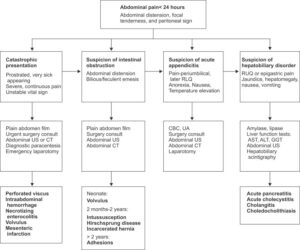
An algorithm regarding the approach has been shown below, with differential diagnoses.
Need Expert Care for Your Child?
For consultations and expert care in Paediatric Surgery and Urology, get in touch with Dr. Apoorva Kulkarni.
Dr. Kulkarni’s Paediatric Surgery and Urology Clinic Healthplanet, OPD No. 3, Laxmi Industrial Premises, Godavari Building, Jay Jaywanti Society, Vartak Nagar, Pokhran Road No. 1, Thane, Maharashtra – 400606
Contact: 90041 10496 Emergency Contact: 83696 31672